Team Members:
Joana De La Torre - joana.delatorre@yale.edu
Troi Slade - troi.slade@yale.edu
Pev Vail - pev.vail@yale.edu
Joshua Rodriguez - joshua.rodriguez@yale.edu
Sponsor:
ASML
Yale School of Engineering & Applied Science
Team Members:
Joana De La Torre - joana.delatorre@yale.edu
Troi Slade - troi.slade@yale.edu
Pev Vail - pev.vail@yale.edu
Joshua Rodriguez - joshua.rodriguez@yale.edu
Sponsor:
ASML
Yale School of Engineering & Applied Science
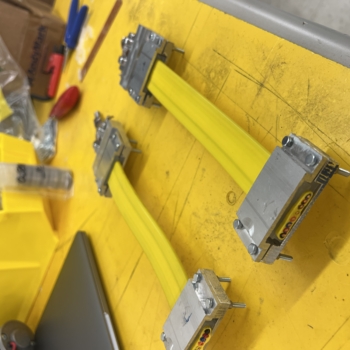
ASML is a company within the semiconductor industry that creates advanced lithography systems. Their machines have a moving top stage and stationary bottom stage, connected by a 5” cable slab that carries power, signal, air, water, and nitrogen. These cables experience wear and failure and ASML devotes a lot of resources into study these failure modes for improvement.
Frictional wear testers available commercially, like pin-on-disk testers, can only provide constant force against the tested surface. ASML’s cable slab competence, and the members of this capstone group, understand this to provide an insufficient representation of the wear experienced by ASML cable slabs, because of the initial impact followed by pure frictional drag associated with their motion profile in the company’s photolithography machines. This is the friction and bump referred to internally as a “frump.”
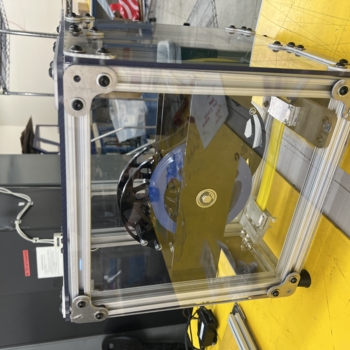
Our design challenge is to develop a compact, modular tester designed to isolate and reproduce friction & bump wear in a controlled and cost-efficient manner. Our system aims to provide a faster and more economical method for evaluating cable slab motion profiles and informing future design decisions. This design is a proof of concept.
The design will be modified and deployed at ASML facilities to evaluate cable slab performance in a controlled environment for future higher-speed and higher-impact testing systems. Key features for improvement include compatibility with ASML standard 5” cable slabs, integrating a cooling system for the motor, and refining the gearbox and motor assembly to reach up to 30G acceleration.
The modular design enables rapid, side-by-side testing of multiple cable slab configurations, supporting efficient comparison and early stage screening. This approach allows for quick identification and prioritization of the most reliable designs while minimizing time and resource investment, when configuring and scaling for ASML testing systems.



We would like to thank Yale SEAS for providing project funding, as well as Dr. Ted Diehl, Dr. Peter Torab, Martin Pfaller, Nicholas Bernardo, Craig Miller, Dave Johnson, Dylan Vansteenbergen, Justin Jadali, Joe Santi, and Nick Johnson and Kathleen Zheng from ASML, for providing advice and support throughout the year.
We would also like to thank our friends, family, and the Mechanical Engineering Class of 2026 for all of their encouragement and guidance.

From Left to Right: Joana De La Torre, Troi Slade, Joshua Rodriguez, Pev Vail
